Showing posts with label Infosec. Show all posts

Sunday, February 5, 2017

STARSHIPRAIDER: Input buffer rev 0.1 design and characterization

Working as an embedded systems pentester is a lot of fun, but it comes with some annoying problems. There's so many tools that I can never seem to find the right one. Need to talk to a 3.3V UART? I almost invariably have an FTDI cable configured for 5 or 1.8V on my desk instead. Need to dump a 1.8V flash chip? Most of our flash dumpers won't run below 3.3. Need to sniff a high-speed bus? Most of the Saleae Logic analyzers floating around the lab are too slow to keep up with fast signals, and the nice oscilloscopes don't have a lot of channels. And everyone's favorite jack-of-all-trades tool, the Bus Pirate, is infamous for being slow.

As someone with no shortage of virtual razors, I decided that this yak needed to be shaved! The result was an ongoing project I call STARSHIPRAIDER. There will be more posts on the project in the coming months so stay tuned!

The first step was to decide on a series of requirements for the project:
  • 32 bidirectional I/O ports split into four 8-pin banks.
    This is enough to sniff any commonly encountered embedded bus other than DRAM. Multiple banks are needed to support multiple voltage levels in the same target.
  • Full support for 1.2 to 5V logic levels.This is supposed to be a "Swiss Army knife" embedded systems debug/testing tool. This voltage range encompasses pretty much any signalling voltage commonly encountered in embedded devices.
  • Tolerance to +/- 12V DC levels.Test equipment needs to handle some level of abuse. When you're reverse engineering a board it's easy to hook up ground to the wrong signal, probe a power rail, or even do both at once. The device doesn't have to function in this state (shutting down for protection is OK) but needs to not suffer permanent damage. It's also OK if the protection doesn't handle AC sources - the odds of accidentally connecting a piece of digital test equipment to a big RF power amplifier are low enough that I'm not worried.
  • 500 Mbps input/output rate for each pin.This was a somewhat arbitrary choice, but preliminary math indicated it was feasible. I wanted something significantly faster than existing tools in the class.
  • Ethernet-based interface to host PC.I've become a huge fan of Ethernet and IPv6 as communications interface for my projects. It doesn't require any royalties or license fees, scales from 10 Mbps to >10 Gbps and supports bridging between different link speeds, supports multi-master topologies, and can be bridged over a WAN or VPN. USB and PCIe, the two main alternatives, can do few if any of these.
  • Large data buffer.Most USB logic analyzers have very high peak capture rates, but the back-haul interface to the host PC can't keep up with extended captures at high speed. Commodity DRAM is so cheap that there's no reason to not stick a whole SODIMM of DDR3 in the instrument to provide an extremely deep capture buffer.
  • Multiple virtual instruments connected to a crossbar.Any nontrivial embedded device contains multiple buses of interest to a reverse engineer. STARSHIPRAIDER needs to be able to connect to several at once (on arbitrary pins), bridge them out to separate TCP ports, and allow multiple testers to send test vectors to them independently.
The brain of the system will be fairly straightforward high-speed digital. It will be a 6-8 layer PCB with an Artix-7 FPGA in FGG484 package, a SODIMM socket for 4GB of DDR3 800, a KSZ9031 Gigabit Ethernet PHY, a TLK10232 10gbit Ethernet PHY, and a SFP+ cage, plus some sort of connector (most likely a Samtec Q-strip) for talking to the I/O subsystem on a separate board.

The challenging part of the design, from an architectural perspective, seemed to be the I/O buffer and input protection circuit, so I decided to prototype it first.

STARSHIPRAIDER v0.1 I/O buffer design

A block diagram of the initial buffer design is shown above. The output buffer will be discussed in a separate post once I've had a chance to test it; today we'll be focusing on the input stage (the top half of the diagram).

During normal operation, the protection relay is closed. The series resistor has insignificant resistance compared to the input impedance of the comparator (an ADCMP607), so it can be largely ignored. The comparator checks the input signal against a threshold (chosen appropriately for the I/O standard in use) and sends a differential signal to the host board for processing. But what if something goes wrong?

If the user accidentally connects the probe to a signal outside the acceptable voltage range, a Schottky diode connected to the +5V or ground rail will conduct and shunt the excess voltage safely into the power rails. The series resistor limits fault current to a safe level (below the diode's peak power rating). After a short time (about 150 µs with my current relay driver), the protection relay opens and breaks the circuit.

The relay is controlled by a Silego GreenPAK4 mixed-signal FPGA, running a small design written in Verilog and compiled with my open-source toolchain. The code for the GreenPAK design is on Github.

All well and good in theory... but does it work? I built a characterization board containing a single I/O buffer and loaded with test points and probe connectors. You can grab the KiCAD files for this on Github as well. Here's a quick pic after assembly:

STARSHIPRAIDER I/O characterization board
Initial test results were not encouraging. Positive overvoltage spikes were clamped to +8V and negative spikes were clamped to -1V - well outside the -0.5 to +6V absolute max range of my comparator.
Positive transient response

Negative transient response


After a bit of review of the schematics, I found two errors. The "5V" ESD diode I was using to protect the high side had a poorly controlled Zener voltage and could clamp as high as 8V or 9V. The Schottky on the low side was able to survive my fault current but the forward voltage increased massively beyond the nominal value.

I reworked the board to replace the series resistor with a larger one (39 ohms) to reduce the maximum fault current, replaced the low-side Schottky with one that could handle more current, and replaced the Zener with an identical Schottky clamping to the +5V rail.

Testing this version gave much better results. There was still a small amount of ringing (less than five nanoseconds) a few hundred mV past the limit, but the comparator's ESD diodes should be able to safely dissipate this brief pulse.
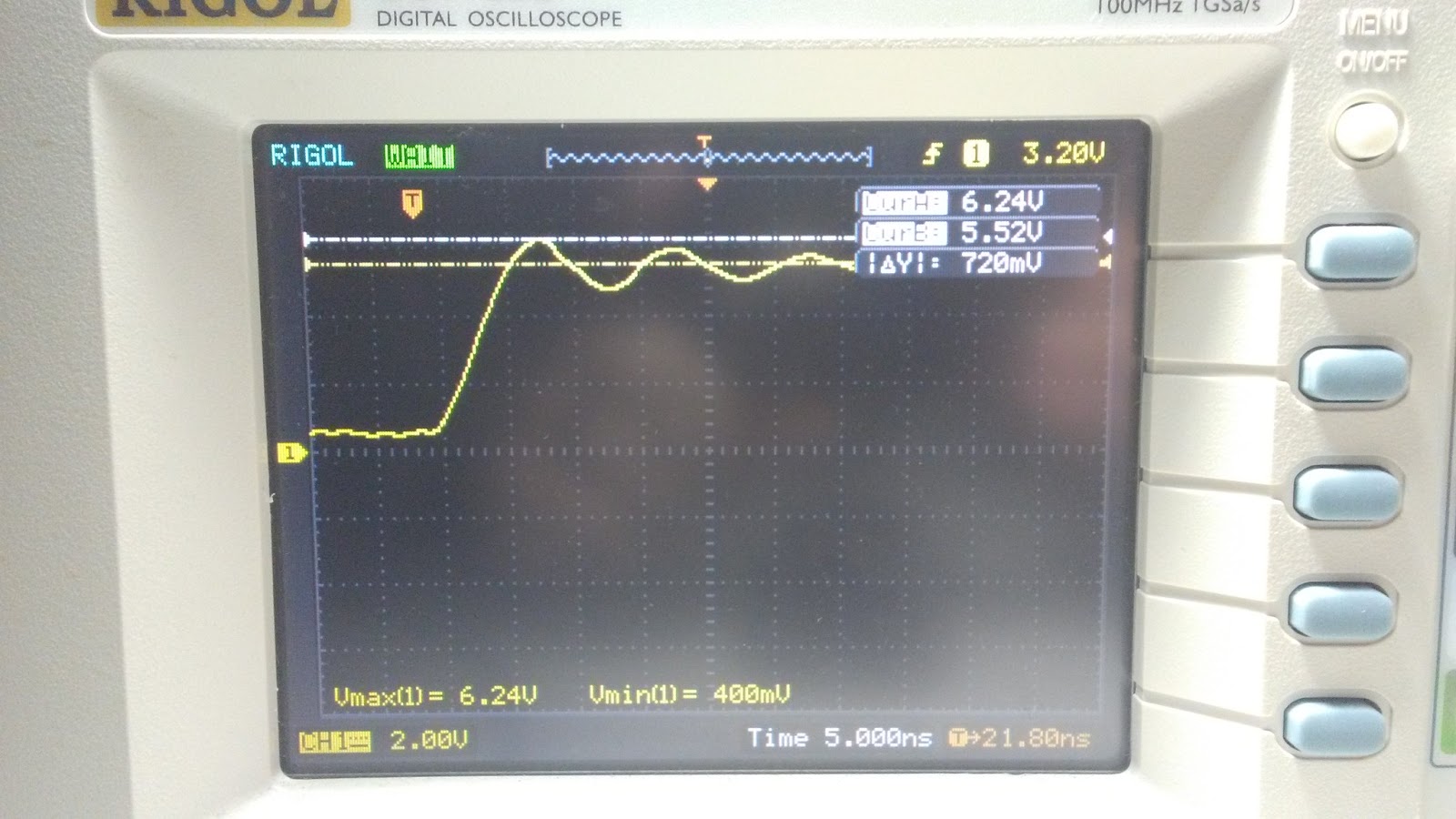
Positive transient response, after rework
Negative transient response, after rework
Now it was time to test the actual signal path. My first iteration of the test involved cobbling together a signal path from an FPGA board through the test platform and to the oscilloscope without any termination. The source of the signal was a BNC-to-minigrabber flying lead test clip! Needless to say, results were less than stellar.

PRBS31 eye at 80 Mbps through protection circuit with flying leads and no terminator
After ordering some proper RF test supplies (like an inline 50 ohm BNC terminator), I got much better signal quality. The eye was very sharp and clear at 100 Mbps. It was visibly rounded at 200 Mbps, but rendering a squarewave at that rate requires bandwith much higher than the 100 MHz of my oscilloscope so results were inconclusive.

PRBS31 eye at 100 Mbps through protection circuit with proper cabling
PRBS31 eye at 200 Mbps, limited by oscilloscope bandwidth
I then hooked the protection circuit up to the comparator to test the entire inbound signal chain. While the eye looked pretty good at 100 Mbps (plotting one leg of the differential since my scope was out of channels), at 200 Mbps horrible jitter appeared.

PRBS31 eye at 100 Mbps through full input buffer
PRBS31 eye at 200 Mbps through full input buffer
After quite a bit of scratching my head and fumbling with datasheets, I realized my oscilloscope was the problem by plotting the clock reference I was triggering on. The jitter was visible in this clock as well, suggesting that it was inherent in the oscilloscope's trigger circuit. This isn't too surprising considering I'm really pushing the limits of this scope - I need a better one to do this kind of testing properly.

PRBS31 eye at 200 Mbps plus 200 MHz sync clock
 At this point I've done about all of the input stage testing I can do with this oscilloscope. I'm going to try and rig up a BER tester on the FPGA so I can do PRBS loopback through the protection stage and comparator at higher speeds, then repeat for the output buffer and the protection run in the opposite direction.

I still have more work to do on the protection circuit as well... while it's fine at 100 Mbps, the 2x 10pF Schottky diode parasitic capacitance is seriously degrading my rise times (I calculated an RC filter -3dB point of around 200 MHz, so higher harmonics are being chopped off). I have some ideas on how I can cut this down much less but that will require a board respin and another blog post!

Saturday, October 4, 2014

Why Apple's iPhone encryption won't stop NSA (or any other intelligence agency)

Recent news headlines have made a big deal of Apple encrypting more of the storage on their handsets, and claiming to not have a key. Depending on who you ask this is either a huge win for privacy, or a massive blow to intelligence collection and law enforcement capabilities. I'm going to try avoiding expressing any opinions of government policy here and focus on the technical details of what is and is not possible - and why disk encryption isn't as much of a major game-changer as people seem to think.

Matthew Green at Johns Hopkins wrote a very nice article on the subject recently, but there are a few points I feel it's worth going into more detail on.

The general case here is that of two people, Alice and Bob, communicating with iPhones while a third party, Eve, attempts to discover something about their communications.

First off, the changes in iOS 8 are encrypting data on disk. Voice calls, SMS, and Internet packets still cross the carrier's network in cleartext. These companies are legally required (by CALEA in the United States, and similar laws in other countries) to provide a means for law enforcement or intelligence to access this data.

In addition, if Eve can get within radio range of Alice or Bob, she can record the conversation off the air. Although the radio links are normally encrypted, many of these cryptosystems are weak and can be defeated in a reasonable amount of time by cryptanalysis. Numerous methods are available for executing man-in-the-middle attacks between handsets and cell towers, which can further enhance Eve's interception capabilities.

Second, if Eve is able to communicate with Alice or Bob's phone directly (via Wi-Fi, SMS, MITM of the radio link, MITM further upstream on the Internet, physical access to the USB port, or using spearphishing techniques to convince them to view a suitably crafted e-mail or website) she may be able to use an 0day exploit to gain code execution on the handset and bypass any/all encryption by reading the cleartext out of RAM while the handset is unlocked. Although this does require that Eve have a staff of skilled hackers to find an 0day, or deep pockets to buy one, when dealing with a nation/state level adversary this is hardly unrealistic.

Although this does not provide Eve with the ability to exfiltrate the device  encryption key (UID) directly, this is unnecessary if cleartext can be read directly. This is a case of the general trend we've been seeing for a while - encryption is no longer the weakest link, so attackers figure out ways to get around it rather than smash through.

Third, in many cases the contents of SMS/voice are not even required. If the police wish to geolocate the phone of a kidnapping victim (or a suspect) then triangulation via cell towers and the phone's GPS, using the existing e911 infrastructure, may be sufficient. If intelligence is attempting to perform contact tracing from a known target to other entities who might be of interest, then the "who called who when" metadata is of much more value than the contents of the calls.

There is only one situation where disk encryption is potentially useful: if Alice or Bob's phone falls into Eve's hands while locked and she wishes to extract information from it. In this narrow case, disk encryption does make it substantially more difficult, or even impossible, for Eve to recover the cleartext of the encrypted data.

Unfortunately for Alice and Bob, a well-equipped attacker has several options here (which may vary depending on exactly how Apple's implementation works; many of the details are not public).

If the Secure Enclave code is able to read the UID key, then it may be possible to exfiltrate the key using software-based methods. This could potentially be done by finding a vulnerability in the Secure Enclave (as was previously done with the TrustZone kernel on Qualcomm Android devices to unlock the bootloader). In addition, if Eve works for an intelligence agency, she could potentially send an NSL to Apple demanding that they write firmware, or sign an agency-provided image, to dump the UID off a handset.

In the extreme case, it might even be possible for Eve to compromise Apple's network and exfiltrate the certificate used for signing Secure Enclave images. (There is precedent for this sort of attack - the authors of Stuxnet appear to have stolen a driver-signing certificate from Realtek.)

If Apple did their job properly, however, the UID is completely inaccessible to software and is locked up in some kind of on-die hardware security module (HSM). This means that even if Eve is able to execute arbitrary code on the device while it is locked, she must bruteforce the passcode on the device itself - a very slow and time-consuming process.

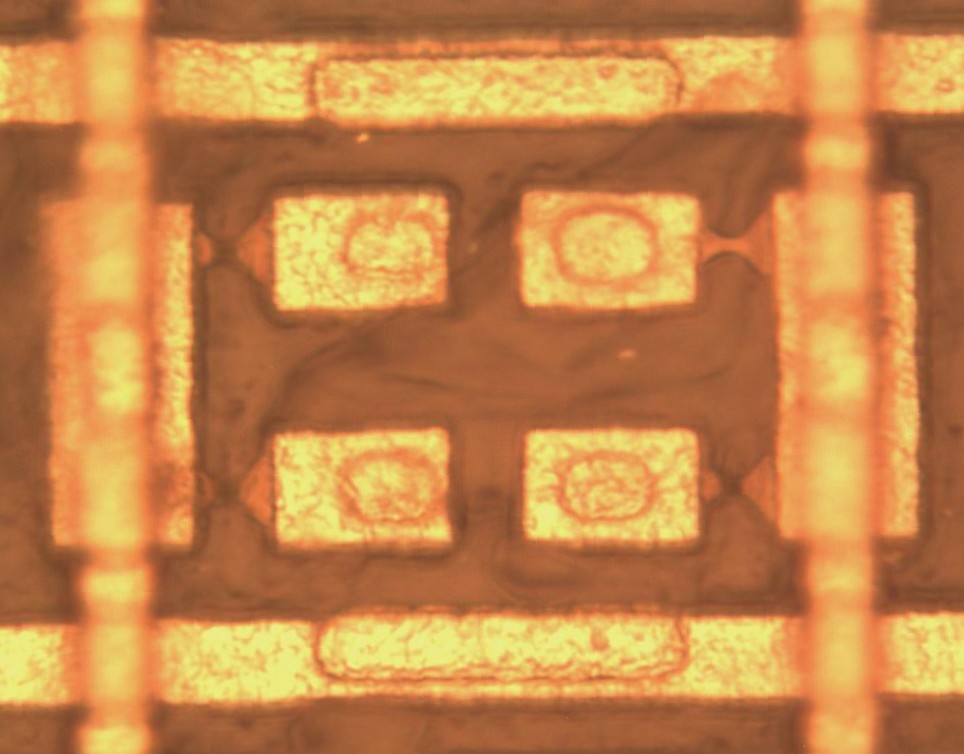
In this case, an attacker may still be able to execute an invasive physical attack. By depackaging the SoC, etching or polishing down to the polysilicon layer, and looking at the surface of the die with an electron microscope the fuse bits can be located and read directly off the surface of the silicon.

E-fuse bits on polysilicon layer of an IC (National Semiconductor DMPAL16R). Left side and bottom right fuses are blown, upper right is conducting. (Note that this is a ~800nm process, easily readable with an optical microscope. The Apple A7 is made on a 28nm process and would require an electron microscope to read.) Photo by John McMaster, CC-BY
Since the key is physically burned into the IC, once power is removed from the phone there's no practical way for any kind of self-destruct to erase it. Although this would require a reasonably well-equipped attacker, I'm pretty confident based on my previous experience that I could do it myself, with equipment available to me at school, if I had a couple of phones to destructively analyze and a few tens of thousands of dollars to spend on lab time. This is pocket change for an intelligence agency.

Once the UID is extracted, and the encrypted disk contents dumped from the flash chips, an offline bruteforce using GPUs, FPGAs, or ASICs could be used to recover the key in a fairly short time. Some very rough numbers I ran recently suggest that an 6-character upper/lowercase alphanumeric SHA-1 password could be bruteforced in around 25 milliseconds (1.2 trillion guesses per second) by a 2-rack, 2500-chip FPGA cluster costing less than $250,000. Luckily, the iPhone uses an iterated key-derivation function which is substantially slower.

The key derivation function used on the iPhone takes approximately 50 milliseconds on the iPhone's CPU, which comes out to about 70 million clock cycles. Performance studies of AES on a Cortex-A8 show about 25 cycles per byte for encryption plus 236 cycles for the key schedule. The key schedule setup only has to be done once so if the key is 32 bytes then we have 800 cycles per iteration, or about 87,500 iterations.

It's hard to give exact performance numbers for AES bruteforcing on an FPGA without building a cracker, but if pipelined to one guess per clock cycle at 400 MHz (reasonable for a modern 28nm FPGA) an attacker could easily get around 4500 guesses per second per hash pipeline. Assuming at least two pipelines per FPGA, the proposed FPGA cluster would give 22.5 million guesses per second - sufficient to break a 6-character case-sensitive alphanumeric password in around half an hour. If we limit ourselves to lowercase letters and numbers only, it would only take 45 seconds instead of the five and a half years Apple claims bruteforcing on the phone would take. Even 8-character alphanumeric case-sensitive passwords could be within reach (about eight weeks on average, or faster if the password contains predictable patterns like dictionary words).

Wednesday, September 17, 2014

Threat modeling for FPGA software backdoors


I've been interested in the security of compilers and related toolchains ever since I first read about Ken Thompson's compiler backdoor many years ago. In a nutshell, this famous backdoor does two things:

  • Whenever the backdoored C compiler compiles the "login" command, it adds a second code path that accepts a hard-coded default password in addition to the user's actual password
  • Whenever the backdoored C compiler compiles the unmodified source code of itself, it adds the backdoor to the resulting binary.
The end result is a compiler that looks fine at the source level, silently backdoors a critical system file at compilation time, and reproduces itself.

Recently, there has also been a lot of concern over backdoors in integrated circuits (either added at the source code level by a malicious employee, or at the netlist/layout level by a third-party fab). DARPA even has a program dedicated to figuring out ways of eliminating or detecting such backdoors. A 2010 paper stemming from the CSAW Embedded Systems Challenge presents a detailed taxonomy of such hardware Trojans.

As far as I can tell, the majority of research into hardware Trojans has been focused on detecting them, assuming the adversary has managed to backdoor the design in some way that provides him with a tactical or strategic advantage. I have had difficulty finding detailed threat modeling research quantifying the capability of the adversary under particular scenarios.

When we turn our attention to FPGAs, things quickly become even more interesting. There are several major differences between FPGAs and ASICs from a security perspective which may grant the adversary greater or lesser capability than with an ASIC.

Attacks at the IC fab


The function of an ASIC is largely defined at fab time (except for RAM-based firmware) while FPGAs are extremely flexible. When trying to backdoor FPGA silicon the adversary has no idea what product(s) the chip will eventually make it into. They don't even know which pins on the die will be used as inputs and which as outputs.

I suspect that this places substantial bounds on the capability of an attacker "Malfab" targeting FPGA silicon at the fab (or pre-fab RTL/layout) level since the actual RTL being targeted does not even exist yet. To start, we consider a generic FPGA without any hard IP blocks:
  • Malfab does not know which flipflops/SRAM/LUTs will eventually contain sensitive data, nor what format this data may take.
  • Malfab does not know which I/O pins may be connected to an external communications interface useful for command-and-control.
As a result, his only option is to create an extremely generic backdoor. At this level, the only thing that makes sense is to connect all I/O pins (perhaps through scan logic) to a central malware logic block which provides the ability to read (and possibly modify) all state in the device. This most likely would require two major subsystems:
  • A detector, which searches I/Os for a magic sync sequence
  • A connection from that detector to the FPGA's internal configuration access port (ICAP), used for partial reconfiguration and readback.
The design of this protocol would be very challenging since the adversary does not know anything about the external interfaces the pin may be connected to. The FPGA could be in a PLC or similar device whose only external contact is RS-232 serial on a single input pin. Perhaps it is in a network router/switch using RGMII (4-bit parallel with double data rate signalling).

I am not aware of any published work on the feasibility of such a backdoor however I am skeptical that a sufficiently generic Trojan could be made simple enough to evade even casual reverse engineering of the I/O circuitry, and fast enough to not seriously cripple performance of the device.

Unfortunately for our defender Alice, modern FPGAs often contain hard IP blocks such as SERDES and RAM controllers. These present a far more attractive target to Malfab as their functionality is largely known in advance.

It is not hard to imagine, for example, a malicious patch to the RAM controller block which searches each byte group for a magic sync sequence written to consecutive addresses, then executes commands from the next few bytes. As long as Malfab is able to cause the target's system to write data of his choice to consecutive RAM addresses (perhaps by sending it as the payload of an Ethernet frame, which is then buffered in RAM) he can execute arbitrary commands on the backdoor engine. If one of these commands is "write data from SLICE_X37Y42.A5FF to RAM address 0xdeadbeef", and Malfab can predict the location of a transmit buffer of some sort, he now has the ability to exfiltrate arbitrary state from Alice's hardware.

I thus conjecture that the only feasible way to backdoor a modern FPGA at fab time is through hard IP. If we ensure that the JTAG interface (the one hard IP block whose use cannot be avoided) is not connected to attacker-controlled interfaces, use off-die SERDES, and use softcore RAM controllers on non-standard pins, it is unlikely that Malfab will be able to meaningfully affect the security of the resulting circuit.

Attacks on the toolchain

We now turn our attention to a second adversary, Maldev - the malicious development tool. Maldev works for the FPGA vendor, has compromised the source repository for their toolchain, has MITMed the download of the toolchain installer, or has penetrated Alice's network and patched the software on her computer.

Since FPGAs are inherently closed systems (more so than ASICs, in which multiple competing toolchains exist), Alice has no choice but to use the FPGA vendor's binary-blob toolchain. Although it is possible in theory for a dedicated team with sufficient time and budget to reverse engineer the FPGA and/or toolchain and create a trusted open-source development suite, I discount the possibility for the scope of this section since a fully trusted toolchain is presumably free of interesting backdoors ;)

Maldev has many capabilities lacking to Malfab since he can execute arbitrary code on Alice's computer. Assuming that Alice is (justifiably) paranoid about the provenance of her FPGA software and runs it on a dedicated machine in a DMZ (so that it cannot infect the remainder of her network), this is equivalent to having full access to her RTL and netlist at all stages of design.

If Alice gives her development workstation Internet access, Maldev now has the ability to upload her RTL source and/or netlist, modify it at will on his computer, and then push patches back. This is trivially equivalent to a full defeat of the entire system.

Things become more interesting when we cut off command-and-control access. This is a realistic scenario if Alice is a military/defense user doing development on a classified network with no Internet connection.

The simplest attack is for Maldev to store a list of source file hashes and patches in the compromised binary. While this is very limited (custom-developed code cannot be attacked at all), many design teams are likely to use a small set of stock communications IP such as the Xilinx Tri-Mode Ethernet MAC, so patching these may be sufficient to provide him with an attack vector on the target system. Looking for AXI interconnect IP provides Maldev with a topology map of the target SoC.

Another option is graph-based analytics on the netlist at various stages of synthesis. For example, by looking for a 32-bit register initialized to 0x67452301, which is in a strongly connected component with three other registers initialized to 0xefcdab89, 0x98badcfe, and 0x10325476, Maldev can say with a high probability that he has found an implementation of MD5 and located the state registers. By looking for a 128-bit comparator between these values and another 128-bit value, a hash match check has been found (and a backdoor may be inserted). Similar techniques may be used to look for other cryptography.

Conclusions

If FPGA development is done using silicon purchased before the start of the project, on an air-gapped machine, and without using any pre-made IP, then some bounds can clearly be placed on the adversary's capability.

I have not seen any formal threat modeling studies on this subject, although I haven't spent a ton of time looking for them due to research obligations. If anyone is aware of published work in this field I'm extremely interested.

Sunday, September 15, 2013

Electronic Privacy: A Realist's Perspective

    Note: I originally wrote this in a Facebook note in March 2012, long before any of the recent leaks. I figured it'd be of interest to a wider audience so I'm re-posting it here.
    There's been a lot of hullabaloo lately about Google's new privacy policy etc so I decided to write up a little article describing my personal opinions on the subject.
    Note that I'm describing defensive policies which may be a bit more cynical than most people's, and not considering relevant laws or privacy policies at all. The assumption being made here is that if it's possible, and someone wants it to happen enough, they will make it happen regardless of whether it's legal.

    RULE 1: If it's on someone else's server, and not encrypted, it's public information.
    Rationale: Given the ridiculous number of data breaches we've had lately it's safe to say that any sufficiently motivated and funded person / agency could break into just about any company storing data they're interested in. On top of this, in many countries government agencies have a history of sending companies subpoenas asking for data they're interested in, which is typically forked over with little or no question.
    This goes for anything from your Facebook profile to medical/financial records to email.
    RULE 1.1: Privacy settings/policies keep honest people honest.
    Rationale: Hackers and government agencies, especially foreign ones, don't have to play by the rules. Services have bugs. Always assume that your privacy settings are wide open and set them tighter only as an additional (small) layer of defense.
    RULE 2: If it's encrypted, but you don't control the key completely, it's public information.
    Rationale: Encryption is only as good as your key management. If somebody else has the key they're a potential point of failure. Want to bet $COMPANY's key management isn't as good as yours? Also, if $COMPANY can be forced/tricked/hacked into turning over the key without your knowledge, the data is as good as public anyway.
    RULE 3: If someone can talk to it, they can root it.
    Rationale: It's pretty much impossible to say "there are no undiscovered bugs in this code" so it's safest to assume the worst... there is a bug in your operating system / installed software and anyone with enough time or money can find or buy an 0day. Want to bet there are NO security-related bugs in the code your box is running? Me neither. If your system isn't airgapped assume it could have been pwned.
    RULE 4: If it goes over an RF link and isn't end-to-end encrypted, it's public information.
    Rationale: This includes wifi (even with most grades of WEP/WPA encryption), cellular links, and everything else of that nature. Sure, the carrier may be encrypting your SMS/voice calls with some proprietary scheme of uncertain security, but they have the key so Rule 2 applies.
    RULE 5: If you have your phone with you, your whereabouts and anything you say is public information.
    Rationale: This can be derived from Rule 3. Your phone is just a computer and third parties can communicate with it. Since it includes a microphone and GPS, assume the device has been rooted and they're logging to $BADGUY on a 24/7 basis.
    RULE 6: All available data about someone/something can and will be correlated.
    Rationale: If two points of data can be identified as related, someone will figure out a way to combine them. Examples include search history (public according to Rule 1), identical usernames/emails/passwords used on different services, and public records. If someone knows that JoeSchmoe1234 said $FOO on GamingForum.com and someone else called JoeSchmoe1234 said $BAR on HackingForum.com it's a pretty safe bet both comments came from the same person who's interested in gaming and hacking.